You Won’t Believe What Brazzaville’s Hidden Architecture Just Revealed
When I first stepped into Brazzaville, I wasn’t expecting much—just another African capital with dusty streets and colonial leftovers. But then I turned a corner and froze. This city doesn’t just have architecture—it breathes it. From bold concrete sculptures to forgotten colonial relics reborn as art spaces, the buildings here tell stories no guidebook ever captured. If you think you know Central African cities, think again. What I found wasn’t just unique—it was quietly revolutionary. The rhythm of life pulses through its walls, echoed in the curves of public halls, the colors of market stalls, and the quiet dignity of repurposed colonial homes. Brazzaville is not a city preserved behind glass; it’s alive, evolving, and speaking through its built environment in ways few capitals dare.
A City That Defies Expectations
Brazzaville stands apart from the common perception of African urban centers. Far from being a collection of improvised settlements or uniform modern developments, it presents a layered urban fabric where history, identity, and innovation converge. As one walks along Avenue Charles de Gaulle or Avenue du Général de Gaulle, the legacy of French urban planning is evident—wide boulevards, symmetrical layouts, and tree-lined avenues that echo 19th-century European ideals. Yet these formal streets give way, without warning, to architectural surprises: structures that rise like sculptural forms, defying conventional design. These are not merely functional buildings; they are statements.
What makes Brazzaville compelling is its refusal to conform. Unlike many postcolonial cities that erased or neglected their architectural pasts, Brazzaville has allowed multiple eras to coexist. The colonial grid remains, but it is now interwoven with bold post-independence constructions, religious edifices with Afro-modernist flair, and informal urban interventions that pulse with local creativity. There is no single architectural doctrine here. Instead, there is dialogue—between past and present, between state-led vision and community-driven adaptation, between imported styles and indigenous expression.
Government buildings from the 1970s and 80s, often constructed with Soviet or Eastern European influence, stand in contrast to the delicate stucco facades of early 20th-century residences. Yet rather than appearing disjointed, this juxtaposition creates a dynamic urban rhythm. It speaks to a city that has not settled into one identity but continues to negotiate its sense of self through built form. For the observant traveler, every block offers a new chapter in this ongoing architectural conversation.
The Legacy of Colonial Design and Its Modern Reinterpretation
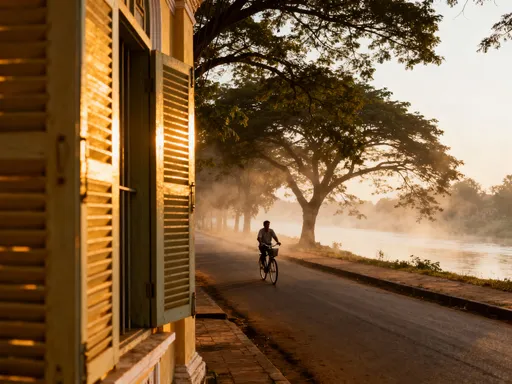
The colonial imprint on Brazzaville remains visible, particularly in neighborhoods such as Bacongo, Makelekele, and Talangaï. These areas were originally developed to serve the administrative and residential needs of French colonial officials, with zoning that reflected the racial hierarchies of the time. The architecture of this era—characterized by high ceilings, shuttered windows, stucco finishes, and shaded verandas—was designed for comfort in the tropical climate, but also for separation. These homes were not built for integration; they were enclaves of power and privilege.
Today, however, these structures have undergone a quiet transformation. Many colonial-era villas, once symbols of foreign authority, have been reclaimed by Congolese families, artists, and entrepreneurs. Some have been converted into cultural centers, art galleries, or boutique workspaces, breathing new life into spaces once closed to the local population. In Bacongo, a former colonial residence now hosts rotating exhibitions of Congolese painters and sculptors. The building’s colonial symmetry remains, but its purpose has shifted—now it serves as a platform for local expression rather than foreign control.
This reclamation is more than physical; it is symbolic. By repurposing these buildings, the city asserts ownership over its own history. The architectural forms remain, but their meaning has changed. A veranda that once offered a view over a segregated garden now opens onto a vibrant street where children play and neighbors gather. The transformation is subtle but profound: architecture once used to enforce distance is now being used to foster connection. This reinterpretation reflects a broader cultural movement—one of reclamation, resilience, and redefinition.
Walking through these neighborhoods, one senses the layers of time. The peeling paint on a colonial wall may hint at neglect, but the bright murals added by residents tell a different story—one of adaptation and pride. These buildings are no longer frozen in the past; they are active participants in the city’s present.
Brutalism with a Congolese Soul
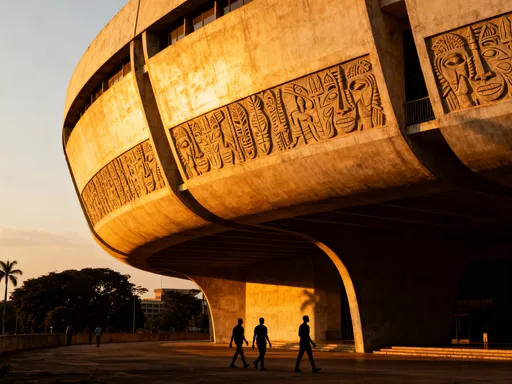
Perhaps the most striking architectural legacy of post-independence Brazzaville is its embrace of Brutalism—a style defined by raw concrete, massive forms, and geometric clarity. Emerging in the 1960s and 70s, this architectural movement coincided with Congo’s assertion of sovereignty and its desire to project strength, modernity, and self-determination. Unlike the delicate ornamentation of colonial design, Brutalist structures in Brazzaville were built to impress—to convey permanence, power, and progress.
The most iconic example is the Palais du Peuple, a monumental government complex located near the Congo River. Its sweeping curves, cantilevered roofs, and sculptural concrete forms make it one of the most distinctive buildings in Central Africa. Designed with input from international architects and local engineers, the Palais was not merely a seat of government; it was a symbol of national ambition. Its interior spaces—vast halls, grand staircases, and column-free assembly chambers—were intended to host the democratic processes of a newly independent nation.
What sets Brazzaville’s Brutalism apart is the subtle integration of local cultural motifs. While the style originated in Europe, its application in Congo was not a mere imitation. Geometric patterns inspired by traditional textiles appear in concrete screens. Roof lines echo the shapes of indigenous thatched structures. Even the orientation of buildings often responds to local climatic conditions—maximizing shade, encouraging airflow, and minimizing solar gain. This adaptation transforms Brutalism from a foreign import into a uniquely Congolese expression.
These buildings were not only political statements but also technical achievements. Constructed during a period of limited resources and infrastructure, they required ingenuity and determination. Many were built using locally produced concrete and labor, with engineers developing innovative techniques to overcome material shortages. The durability of these structures—many of which remain in use today—is a testament to their quality and the pride with which they were built.
Today, the Palais du Peuple and similar structures continue to serve their original functions, but they also attract a new kind of visitor: architecture enthusiasts, photographers, and students of urban design. They stand as monuments not to authoritarianism, as some critics have claimed, but to a moment of national confidence—a time when Congo believed in its ability to shape its own future, one concrete slab at a time.
Religious Structures as Architectural Statements
In Brazzaville, places of worship are not hidden away; they are integral to the city’s architectural landscape. Churches and mosques rise as bold forms, often becoming landmarks in their own right. Unlike the understated religious buildings found in many Western cities, those in Brazzaville embrace visibility, color, and symbolic design. They are not just spaces for prayer—they are declarations of faith, culture, and community identity.
Catholic cathedrals in the city exhibit a distinctive Afro-modernist style. One such example is the Cathédrale Sacré-Cœur, whose angular rooflines and exposed concrete structure reflect mid-century modernism, yet its interior is rich with local symbolism. Stained glass windows depict biblical scenes with African figures, and wooden carvings incorporate traditional motifs. The play of light through colored glass creates a spiritual atmosphere that is both modern and deeply rooted in place. The building does not imitate European cathedrals; instead, it reimagines them for a Congolese context.
Islamic centers in Brazzaville demonstrate a similar fusion. Mosques feature minarets that rise with elegant tapering forms, often adorned with geometric patterns inspired by both Islamic art and local textile designs. The use of perforated concrete screens—known as mashrabiya—provides shade while allowing ventilation, a practical response to the humid climate. Some newer mosques incorporate domes made of lightweight materials, enabling expansive interior spaces without excessive structural support.
What unites these religious buildings is their openness. Courtyards, arcades, and shaded walkways invite gathering before and after services. These spaces become extensions of the neighborhood, hosting conversations, children at play, and informal commerce. Architecture here serves not only ritual but also social cohesion. In a city where community ties remain strong, religious structures function as both spiritual and civic centers.
Moreover, the placement of these buildings within the urban fabric is significant. Often situated at major intersections or elevated points, they are visible from afar, serving as orientation points in the city. Their presence reminds residents and visitors alike that faith is not private—it is woven into the public realm, expressed through form, material, and light.
Informal Architecture and Urban Creativity
Beyond the formal city—beyond ministries, cathedrals, and colonial villas—lies another architectural world: the informal, the adaptive, the everyday. This is where Brazzaville’s true creativity shines. In markets like Marché Total, Makélékélé, and Marché Djoué, architecture is not dictated by blueprints but shaped by necessity, ingenuity, and imagination. Here, the built environment is fluid, constantly evolving in response to need and opportunity.
Walk through any of these markets, and you’ll see structures made from corrugated metal, reclaimed wood, and repurposed shipping containers. Walls are painted in vibrant colors—turquoise, crimson, sunflower yellow—with hand-lettered signs advertising everything from phone credit to secondhand clothes. These facades are not static; they change weekly, even daily, as vendors adapt their spaces. A kiosk might start as a simple shelter but grow into a multi-level structure with awnings, storage lofts, and display shelves.
What emerges is a kind of vernacular architecture—one born not from academic training but from lived experience. These structures are designed for function: to protect goods from rain, to attract customers, to maximize visibility. Yet they also express identity. A vendor’s choice of color, pattern, or signage becomes a personal signature. Some stalls resemble small works of art, with intricate metalwork, patterned screens, or murals depicting Congolese musicians and heroes.
This informal architecture is often overlooked by official urban planning, yet it plays a vital role in the city’s economy and social life. Markets are not just places to buy and sell; they are hubs of information, connection, and cultural exchange. The design of these spaces—organic, flexible, responsive—reflects a deep understanding of urban life. Unlike rigid, top-down planning, this architecture grows from the ground up, shaped by the people who use it every day.
For the visitor, these markets offer a more intimate experience of Brazzaville than any museum or monument. They reveal the city’s pulse—the energy, the humor, the resilience. To appreciate them is to understand that architecture is not only about permanence but also about adaptation, about making space for life as it is lived.
The Role of Public Spaces in Shaping Urban Identity
Public spaces in Brazzaville are not afterthoughts; they are central to the city’s identity. They serve as stages for national memory, sites of daily interaction, and places where architecture and life intersect. Two of the most significant are the Place de l'Indépendance and the Malecón along the Congo River—each offering a different expression of urban belonging.
The Place de l'Indépendance is a vast ceremonial plaza surrounded by government buildings, including the Palais du Peuple and the former Ministry of Defense. At its center stands a towering monument commemorating Congo’s independence from France in 1960. The plaza is designed for gathering—on national holidays, it fills with citizens celebrating with music, dance, and speeches. The architecture around it reinforces this role: broad facades, open staircases, and colonnades create a sense of grandeur and accessibility. This is not a space for passive observation; it is meant to be occupied, activated, and claimed by the people.
In contrast, the Malecón—a riverside promenade stretching along the banks of the Congo River—offers a more relaxed, everyday kind of public life. Here, families stroll in the evening, fishermen cast their lines, and street vendors sell grilled fish and fresh coconut water. The architecture along the Malecón is low-rise and open, with cafes, viewing platforms, and shaded seating areas. The design prioritizes views of the river and the distant skyline of Kinshasa, just across the water. It is a place of leisure, but also of connection—between people, between cities, between nature and the built environment.
What both spaces share is a commitment to public access. Unlike privatized plazas or gated developments, these areas belong to everyone. They are maintained not through commercial interest but through civic pride. Their design—simple, durable, and human-scaled—invites use rather than restricting it. In a city where inequality persists, such spaces are vital. They offer a sense of shared ownership, a reminder that the city is not just for the powerful, but for all who live in it.
These public spaces also reflect a broader African urban philosophy—one that values community over isolation, gathering over exclusion. They are not manicured or controlled; they are lived-in, sometimes messy, always alive. In them, architecture does not dominate; it facilitates.
Challenges and the Future of Urban Design
Despite its architectural richness, Brazzaville faces significant challenges. Rapid urbanization, population growth, and infrastructure strain threaten to overwhelm the city’s historic fabric. Informal settlements expand without planning, and new construction often prioritizes speed and cost over design quality. Many colonial and post-independence buildings, already aging, suffer from neglect. Without formal preservation policies, some risk demolition or irreversible alteration.
Climate pressures add another layer of complexity. Rising humidity, heavy rainfall, and intense sun degrade materials, especially concrete and paint. While traditional designs once responded intelligently to these conditions, many new buildings do not. Air conditioning and imported materials replace passive cooling strategies, increasing energy use and disconnecting architecture from its environment.
Yet there are reasons for hope. A growing number of local architects, urban planners, and cultural organizations are working to document, protect, and celebrate Brazzaville’s architectural heritage. NGOs have launched initiatives to catalog significant buildings, train young preservationists, and advocate for policy changes. Some universities now offer courses in African urbanism, encouraging students to study their own cities with fresh eyes.
Moreover, new projects are beginning to reflect a renewed sensitivity to context. Some contemporary buildings incorporate traditional materials like laterite stone or bamboo, while others revive passive ventilation techniques. Community-led design efforts are emerging, ensuring that new developments respond to local needs rather than external models. There is a growing awareness that modernity does not require erasing the past—that innovation can coexist with memory.
The future of Brazzaville’s architecture depends on choices being made today. Will the city allow its unique built heritage to fade, or will it invest in preservation and thoughtful development? Can it balance growth with identity, progress with continuity? The answers will shape not only the skyline but the soul of the city.
Brazzaville’s architecture isn’t just about buildings—it’s about identity, resistance, and reinvention. Every structure, from grand ministries to street-corner kiosks, carries a message: this city refuses to be invisible. For travelers seeking authenticity beyond the usual routes, Brazzaville offers a rare gift—architecture that speaks. And if you listen closely, it whispers something powerful about Africa’s urban future.